
Dear Professor Shiller, on the occasion of your 80th birthday, please accept this brief reflection as a gesture of deep respect for your work, which has profoundly shaped our understanding of financial markets and inspired further theoretical developments.
Prof. Stasys Albinas Girdzijauskas
Vilnius University
Can a market “resonate”? At first glance, such a question may seem metaphorical. Yet a closer look at financial history—from the dot-com bubble to the 2008 crisis and recent cryptocurrency cycles—suggests that, at certain moments, economic systems behave in ways strikingly similar to resonance phenomena.
One of the first scholars to systematically reveal the internal logic of such processes was Nobel Prize laureate Robert J. Shiller, whose work fundamentally reshaped our understanding of financial market dynamics. His research demonstrated that markets are not merely outcomes of rational decision-making; rather, they function as self-reinforcing systems driven by expectations, narratives, and collective psychology.
Synergy: When Forces Reinforce Each Other
Shiller’s work makes it possible to clearly identify the presence of synergy in economic systems. Rising prices foster optimism, optimism increases demand, and demand further drives prices upward. This process is not random—it is a feedback mechanism in which different factors begin to amplify one another.
Importantly, this synergy is not purely psychological. It involves:
- credit expansion,
- asset price growth,
- investor behavior,
- the diffusion of information and narratives.
In this way, the market evolves from a simple dynamic into a self-reinforcing system.
Resonance: When the System Becomes Sensitive
However, synergy alone does not imply crisis. On the contrary, it is often perceived as a desirable phase by investors. The critical shift occurs when the system reaches a state in which even small impulses trigger disproportionately large reactions.
This condition may be described as economic resonance.
Shiller captures this state phenomenologically: at the peak of bubbles, markets become excessively sensitive, and price fluctuations detach from fundamental values. Yet his work does not specify the structural boundary at which this transition occurs.
It is precisely here that a deeper explanation becomes possible.
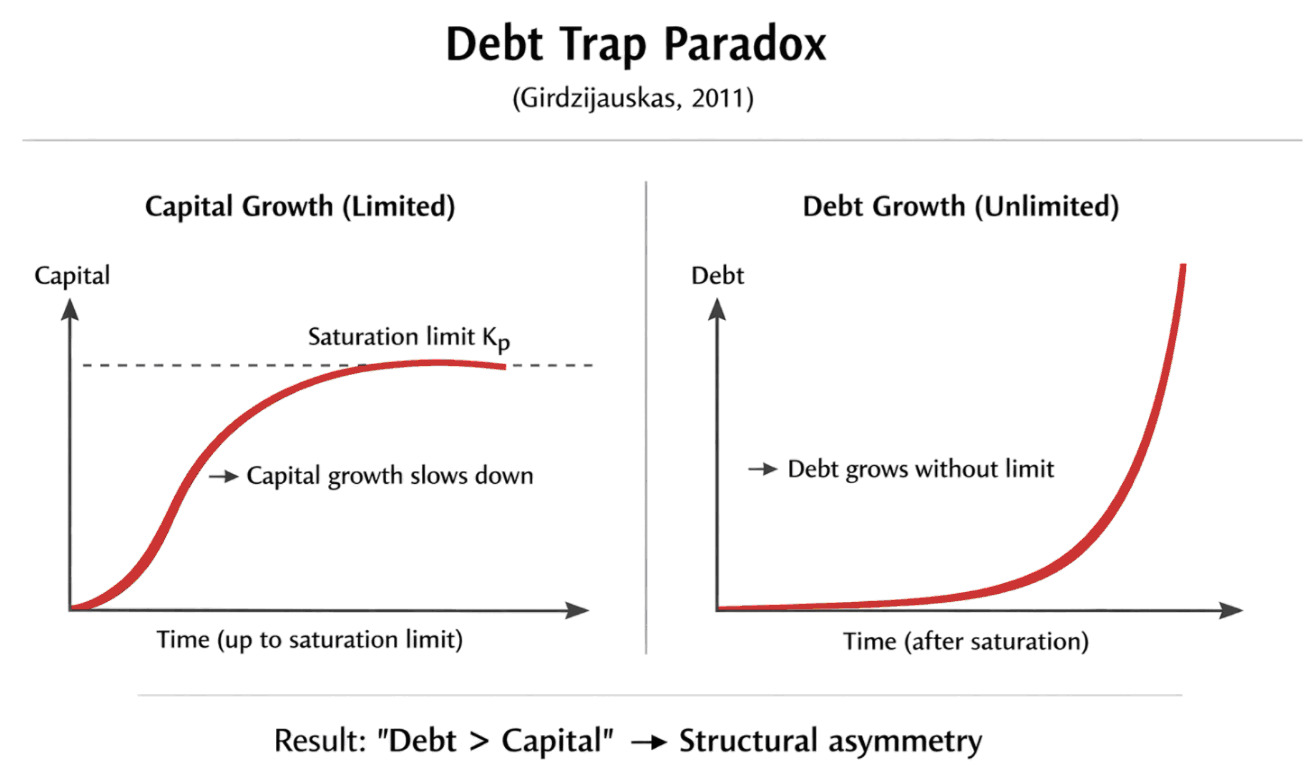
Figure 1. In a saturated system, capital growth is limited by market capacity, and debt can continue to grow – so even a small negative impulse causes a disproportionately large reaction.
This structural asymmetry explains why resonance becomes destabilizing precisely at high levels of saturation.
Saturation as a Structural Limit
A crucial implication follows from this perspective. If economic growth were unlimited, neither resonance nor the debt trap paradox would emerge as systemic phenomena. Synergy would remain a purely positive force, continuously supporting expansion without destabilizing consequences.
It is precisely the presence of saturation — that is, the inherently limited and logistic nature of growth — that gives rise to these effects. In this sense, resonance, asymmetry, and debt accumulation are not anomalies, but natural outcomes of a system approaching its capacity.
Thus, these phenomena can be understood as consequences of a new growth paradigm — one based on saturation, described by logistic (Verhulst–Girdzijauskas) dynamics, rather than by the assumption of unlimited expansion.
Financial saturation theory interprets this process as the system’s approach to its capacity limit. As long as the market remains unsaturated, synergy supports growth. However, as the system approaches its limits, stability begins to erode.
At this stage, synergy transforms into resonance.
In other words, the very mechanisms that previously sustained growth begin to generate instability.
Importantly, saturation should not be understood as a fixed external limit, but as a dynamic state variable describing how close the system is to its effective capacity.
Debt and Asymmetry: The Second Paradox
It is essential to emphasize that the mechanism of crisis is not purely dynamic; it also has a structural dimension.
Under conditions of saturation, capital growth encounters natural limits, whereas debt expansion does not. This creates a fundamental imbalance: the system can accumulate obligations faster than it can generate real value.
This imbalance gives rise to what may be termed the debt trap paradox (Girdzijauskas, 2011), which manifests as loss–gain asymmetry: negative shocks have a stronger impact than positive ones.
This is not merely a psychological phenomenon. It is a structural property of the system.
Two Logics – One System
From this perspective, two interrelated but distinct mechanisms can be identified:
- synergy and resonance, which describe the dynamic behavior of markets and are essential drivers of growth and innovation;
- debt and saturation, which describe the structural state of the system.
Under normal conditions, synergy supports economic development. However, when combined with saturation and excessive debt, it may transform into a destabilizing force.
From Shiller to a Deeper Explanation
Shiller’s contribution remains fundamental because it revealed that markets can behave as self-reinforcing and unstable systems. However, his work primarily describes the observable surface of these processes.
Financial saturation theory seeks to address a different question: why such phenomena arise at particular moments and why they become inevitable.
In this sense, the two approaches are not competing but complementary. The present reflection may be understood as an attempt to take one step beyond Shiller’s phenomenological observations—not by contradicting them, but by providing a structural explanation of the same processes.
Conclusion
Economic crises are not random events. They emerge when self-reinforcing synergy transforms into a resonant state, while the structural system—constrained by limited capacity and expanding debt—becomes asymmetrically vulnerable.
The key lesson is therefore simple:
economic stability depends not only on growth, but on how close the system is to its limits.
It is not synergy that creates crisis—it is synergy that, in a saturated and debt-burdened system, turns into resonance.
With deep respect for your contribution to economic thought and its lasting impact on how we understand financial markets.
Prof. Stasys Albinas Girdzijauskas
Vilnius University
ORCID: 0009-0006-7057-276X
Note on the use of artificial intelligence.
This article was prepared with the assistance of artificial intelligence (ChatGPT) as a reflective tool for structuring ideas and improving clarity. Full responsibility for the content, arguments, and conclusions rests with the author.
References
Girdzijauskas, S. (2011). Sovereign Debt Crisis: Logistic Analysis. Vilnius University Press.
Girdzijauskas, S. (2024). Economic Crises: Insights from Financial Saturation Theory. VUP.
Girdzijauskas, S. A. (2026). Loss–gain asymmetry as a law of saturation state. Mokslo Lietuva. https://mokslolietuva.lt/2026/01/naudos-nuostolio-asimetrija-kaip-prisotinimo-busenos-desnis/