
What connects 16th-century Jesuit theatre, today’s students’ search for identity, and theatre studies in war-torn Ukraine? At first glance – very little. Yet these themes reveal how the role of university theatre has shifted across different eras and why it remains relevant today.
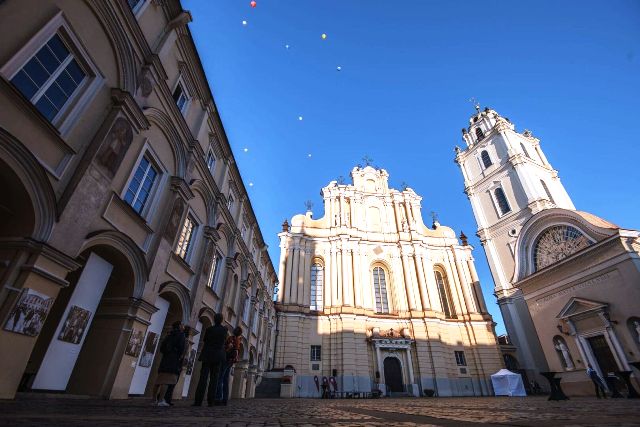 At the XIII World Congress of the International University Theatre Association (AITU-IUTA), taking place at Vilnius University on 8–13 July, the keynote speakers will invite attendees to explore university theatre from different perspectives – from its historical roots in Europe to the contemporary challenges faced by young people and theatre communities around the world.
Theatre that began Lithuania’s theatre history
The opening keynote will be delivered by Dr. Liudas Jovaiša, Associate Professor at the Faculty of History of Vilnius University and one of Lithuania’s foremost researchers of Church history and Jesuit culture. A historian who has worked at Vilnius University for more than two decades, he studies early modern culture, education, and religion in Lithuania. In 2025, he was voted the best lecturer at the Faculty of History of Vilnius University.
In his talk „Jesuit Theatre from Messina to Vilnius: docere, delectare, movere“, the scholar will trace the origins of university theatre in Europe – from the first performances at the Jesuit college in Messina, Sicily, to Vilnius, where in 1570 the first known performance in Lithuanian history was staged.
According to the researcher, Jesuit theatre was more than an educational tool. It became one of the most important instruments of cultural communication, shaping societal values, cultivating rhetoric, and uniting urban communities. This tradition would later influence theatre across Europe and some of the most celebrated Western playwrights.
The university as a place to find oneself
A different perspective will be offered by sociologist Dr. Milda Pivoriūtė. A lecturer and researcher at Vilnius University, she has spent many years studying the themes of identity formation, life choices, and the so-called quarter-life crisis among young people. Her research explores how contemporary young adults navigate professional paths, independence, and the search for meaning in a rapidly changing world.
In her talk „The University (and Its Theatre) as a Space for Young People’s Self-Rehearsals“, Dr. Pivoriūtė will argue that the university today has become not only a place of study but of self-discovery. Young people come here seeking answers to questions about who they are, what kind of life they want to build, and which direction to take.
According to her research, creative activities – and university theatre in particular – can provide a safe space to experiment, make mistakes, try on different roles, and discover one’s identity. University theatre therefore fulfils far more than an artistic function: it contributes to the social and emotional development of young people.
Theatre studies in wartime
One of the most anticipated presentations at the congress will focus on Ukraine.
Mykhailo Urytskyi, Professor, director, and theatre educator at the Kyiv National I. K. Karpenko-Kary Theatre, Cinema and Television University, will present how theatre studies in Ukraine have changed since the full-scale Russian invasion that began in 2022.
In his talk „Theatre Education in Ukraine amid a Full-Scale War: New Circumstances, New Challenges, New Opportunities“, he will speak about a period when students and teachers were forced to leave their homes, relocate to other cities, or go abroad. Many European universities welcomed Ukrainian students to continue their studies, while theatre schools sought ways to sustain the educational process amid constant air raid alerts, power outages, and security threats.
The presentation will reveal not only the challenges but also the new opportunities that have emerged. The war has spurred international collaboration and the development of new forms of teaching. Congress participants will also see photographs and video material documenting university life and theatre studies during wartime.
These three keynotes reflect different faces of university theatre – its historical roots, its significance to young people today, and its capacity to endure even in the most difficult circumstances. That is precisely why they will be among the most important highlights of the XIII World AITU-IUTA Congress in Vilnius.
The keynote lectures will take place in the Aula Parva in Vilnius University (Universiteto g. 3) and will begin at 9:30 AM.
9 July – Assoc. Prof. Dr. Liudas Jovaiša
„Jesuit Theatre from Messina to Vilnius: docere, delectare, movere“
The lecture will be delivered in English.
10 July – Dr. Milda Pivoriūtė
„The University (and Its Theatre) as a Space for Young People’s Self-Rehearsals“
The lecture will be delivered in Lithuanian with simultaneous interpretation into English.
11 July – Prof. Mykhailo Urytskyi
„Theatre Education in Ukraine amid a Full-Scale War: New Circumstances, New Challenges, New Opportunities“
The lecture will be delivered in English.
Further information about the congress, the full programme, and details about other speakers can be found at: www.congress2026.kc.vu.lt.