
On Tuesday, 30 June at 15:00, Vilnius University (VU) will hold its tenth annual Memory Diploma ceremony at St Johns’ Church, to honour former members of the University community who were expelled during the years of occupation. This year, Memory Diplomas will be awarded to 46 former VU students and staff members.
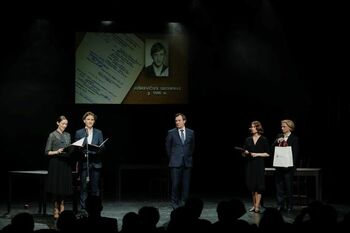 ‘The University acknowledges its responsibility for the morally flawed institutional decisions that were dictated by external political circumstances. Through the Memory Diploma initiative, we symbolically remember and honour members of our community who were expelled and prevented from continuing their studies or employment. It is both a conscious choice and an invitation not to conceal or gloss over the wounds of history, but to confront them honestly and openly, to understand them and reflect upon them,’ said VU Rector Prof. Rimvydas Petrauskas.
Among this year’s 46 recipients – former students and academic staff of Jewish, Lithuanian, and Polish origin – is Elena Šuliauskaitė, Sister Gerarda, who was one of the publishers of the underground periodical ‘Lietuvos Katalikų Bažnyčios kronika’ (‘Chronicle of the Catholic Church in Lithuania’), a participant in the non-violent resistance to the Soviet occupation regime, and a recipient of the Freedom Prize.
More than 50 years ago, she was dismissed from her position as Senior Laboratory Assistant at the Department of the History of the Lithuanian SSR in the Faculty of History and Philology of the then Vilnius Vincas Kapsukas State University, ‘because of her religious beliefs and anti-Soviet activities’.
Sister Gerarda recalls that, each day on her way to work, she wondered how much longer she would be allowed to stay, constantly expecting to be summoned to the Rectorate. ‘I knew that one day the call would come. The University’s Communist Party activists gathered for the meeting, and I was told directly: “You belong to the Congregation of the Handmaids of Christ the King; therefore, you cannot work with young people”,’ she recounted.
The University administration urged her to submit a resignation of her own accord, warning that otherwise her employment record would state that she was unfit for academic work. As a result, she was forced to leave VU ‘voluntarily’.
This year’s recipients also include the renowned Lithuanian partisan Stasys (Stanislovas) Lukša-Juodvarnis, brother of the well-known freedom fighter Juozas Lukša-Daumantas. In March 1947, while still a student, he was expelled from the Faculty of Chemistry for failing to attend lectures and practical classes. Later that same year, he was killed in action in the forests near Kazlų Rūda when Soviet forces attacked the military training school for non-commissioned officers of the Tauras Military District.
Stasys Lukša’s Memory Diploma, together with several others, will be presented to family members attending the ceremony on behalf of the honourees. The remaining diplomas will be transferred to the VU Museum after the names of those being honoured have been read aloud during the ceremony, as neither the recipients nor their relatives could be traced.
The Memory Diploma symbolises VU’s acknowledgement of mistakes made in its history and serves as a sign of respect for former members of the University community who suffered injustice.
The diploma and the public award ceremony are part of the ‘Recovering Memory’ initiative, which is based on historical research. The initiative aims to assess the impact of totalitarian regimes on the VU community, identify those who suffered under these regimes, and symbolically restore these individuals to the University community.
According to the initiator of the ‘Recovering Memory’ project, Prof. Jurgita Verbickienė from the VU Faculty of History, when research into people expelled from the University began a decade ago, it uncovered not only archival records but also the complex moral choices people faced. This project tells the stories of people who, under totalitarian regimes, chose to help, shelter, and save others. It reminds us that even in the darkest of times, there is always the possibility of staying human.
‘The ‘Recovering Memory’ initiative is about choices… about choosing compassion. It offers a kind of antidote, showing what can happen when one acts against our human nature, when we fail to help one another. The choices people made in the past, as well as those we make today, are especially important now as the world once again grows unstable. The importance and growing relevance of initiatives like this – initiatives that inspire and demonstrate examples of civic resilience – are further reflected in this year’s prestigious St Christopher statuette bestowed on the ‘Recovering Memory’ initiative. I believe it is important for all of us to realise that the University’s initiatives do more than transform its own academic community – they are recognised and have an impact on society as a whole. I recently found myself reflecting that although we present a single Memory Diploma to one individual, the restoration of justice extends far beyond that person, touching their family and generations to come,’ said Prof. Verbickienė.
At present, around 1,000 people could be eligible to receive a Memory Diploma. During the years of occupation, they were prevented from studying or working at the University solely because of their ethnicity, beliefs, perceived disloyalty to the regime, social background, deportation (their own or that of their relatives), or their ties to Lithuanian partisans and resistance fighters.
To date, around 350 individuals living in Lithuania, the United States, Israel, Poland, and France have already been honoured through the initiative.